Green Labels, Grey Plastic: What Compatible Ink Actually Costs the Planet
Photo: Dinkun Chen, CC BY-SA 4.0, via Wikimedia Commons
Walk down the ink aisle of any UK supermarket and you will see a lot of green. Recycled card, a leaf, a word like 'eco' or 'planet' or 'responsible'. What you will not see is anything that lets you compare one cartridge with another on the thing that actually matters: grams of carbon per page printed.
That number exists, roughly, but nobody puts it on the box. So here is a householder's guide to working it out for yourself.
Where the carbon actually sits
For a typical inkjet cartridge, the environmental cost is spread across four places, in roughly this order of importance for most UK homes:
- Yield — how many pages you get before the thing runs dry, and how many of those pages were wasted.
- The shell — virgin plastic, remanufactured plastic, or something bio-based.
- Manufacture and filling — energy, water, and the electronics in a chipped cartridge.
- Shipping and packaging — small, but not nothing, especially for air-freighted stock.
The first one dwarfs the rest. A cartridge that prints 500 useful pages has a very different footprint per page from one that prints 150, even if both are made from identical plastic in the same factory.
The plastic question
Original manufacturer cartridges are overwhelmingly made from virgin plastic. That is the baseline.
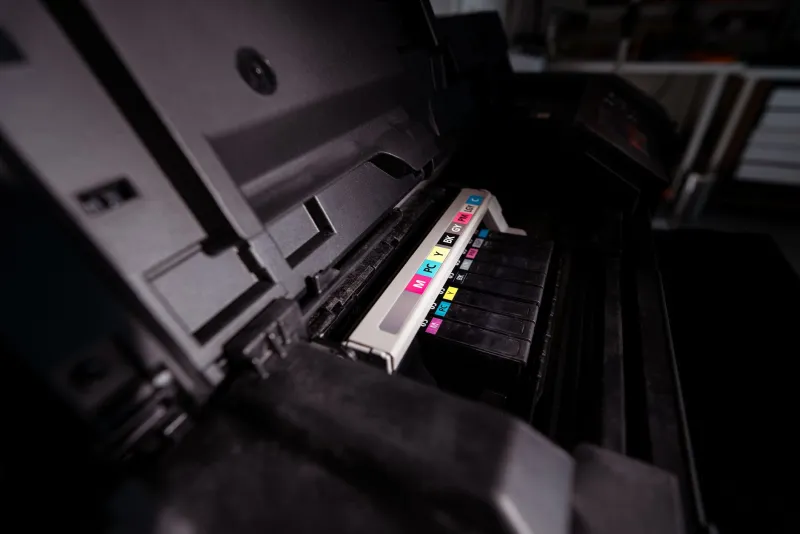
Compatible cartridges come in three broad flavours. New-build compatibles use new plastic moulded to fit. Remanufactured cartridges reuse an original shell — cleaned, refilled, new chip — which avoids the moulding energy and keeps plastic in circulation for another cycle. Refillable or eco-shell designs use lighter or recycled-content plastic.
Sellers are not always clear about which one you are buying. If the listing does not say, ask. A supplier who cannot tell you whether a cartridge is new-build or remanufactured is a supplier who has not thought about it, and that tells you something.
Yield is the multiplier nobody advertises
Two cartridges with identical plastic can have wildly different footprints per page. The inkjet standard most manufacturers quote is ISO/IEC 24711, based on a standardised test document at around 5% coverage. Mono laser cartridges usually reference ISO/IEC 19752.
That 5% figure is the catch. A page of dense text at 12pt is roughly in that territory. A page with a colour header, a logo and a photo is not. If half your printing is colourful, your real yield might be half the quoted figure — which doubles the footprint per page.
The greener cartridge is often simply the one you use efficiently. Duplex printing, grayscale defaults, and not reprinting the same letter three times because someone lost it do more than any label claim.
Shipping: light but bulky
Cartridges are not heavy, but they are awkward shapes, which means a lot of packaging volume for the weight. Air freight is dramatically more carbon-intensive per kilo than sea freight, and a single cartridge ordered on next-day delivery from the other side of the world is about the worst combination available.
What helps: buying multipacks rather than singles, ordering with your other household bits rather than as a lone express parcel, and choosing a supplier who describes their stock as UK-based or European. A compatible cartridge made in the UK and posted second class can beat a branded cartridge flown in from Asia, even before you factor in the plastic.
The recycling route in the UK
Here is the uncomfortable bit. Your kerbside collection will not take cartridges. Not the black bin, not the recycling bin.
What does work:
- Retailer drop-off points. Many supermarkets and stationery shops have a collection box near the front.
- Charity schemes. Several UK charities run cartridge collection schemes that raise funds per unit returned, with freepost envelopes or drop-off points.
- Manufacturer take-back. The big brands offer prepaid envelopes or envelopes included with plan cartridges.
- Household waste and recycling centres. For printers themselves, not cartridges — that is WEEE territory, and it should never go in the bin.
One honest caveat: most cartridge recycling is downcycling. The plastic is reground and used for lower-grade products rather than becoming a new cartridge. That is still better than landfill, but it is not circular. Remanufacturing, where the shell is genuinely reused, is a stronger outcome than recycling, which is why it is worth asking which one your supplier means when they say 'recyclable'.
The bigger lever for a household is simpler: return every empty you produce. A cartridge in a drawer is a cartridge that will eventually go in the bin.
The failure mode that undoes everything
A compatible cartridge that leaks, clogs, or gets rejected by a firmware update has an environmental cost far above its price. You waste the ink, the plastic, the shipping, and the paper you were printing on — and then you buy another one.
This is why a returns policy is an environmental feature, not just a consumer right. Buying from a UK supplier who will replace a dud without a fight is greener than buying the cheapest listing on a marketplace and binning the failures. It also means fewer half-used cartridges rattling around in a drawer because you gave up on them.
A quick greenwash checklist
Before you buy, look for these five things. If a listing has three or more, it is probably a supplier who actually knows what they are selling.
- Recycled content stated as a percentage by weight, not just 'recycled packaging'.
- A take-back or freepost returns scheme for empties.
- Yield quoted against a recognisable standard (ISO/IEC 24711 or 19752), not just a big number.
- A clear statement of whether the cartridge is new-build or remanufactured.
- Plastic-free or easily recyclable packaging, and delivery consolidated into one parcel.
None of these is a guarantee. All of them are checkable.
What actually moves the needle
Ranked by impact for a normal UK household:
- Print less. The greenest page is the one you read on screen.
- Default to mono and duplex. Halves your paper and most of your colour ink.
- Choose high-yield cartridges for the colours you actually use. Buying XL black and standard colour matches most homes.
- Return every empty. Set up a small box by the door and post them back in batches.
- Buy in fewer, larger orders from a UK-based supplier.
- Keep the printer for years. The embodied carbon of the machine dwarfs everything you put in it.
The verdict
Compatible cartridges are not automatically greener than branded ones, and branded ones are not automatically worse. The honest position is that the difference usually comes down to remanufacturing, yield and returns handling — and that a well-chosen compatible from a UK supplier with a real take-back scheme is very likely to beat a branded cartridge flown in for next-day delivery.
Ignore the leaf. Ask about the plastic, the yield standard and the freepost envelope. Those three answers tell you more than any box ever will.